Blog!
Still the best name for a set of chronologically-ordered articles.
You have rhythm
Video and text of a 5-minute "soapbox" talk I gave about a topic I am passionate about: everyone has rhythm. I can prove it!
I was invited to give a 5-minute "soapbox" talk on a subject I am passionate about. This is what I came up with. There is a video below and the text that I spoke from.
🙂 enjoy 🙂
(the video will start skipped to my part)
You have rhythm.
I’m up on this soapbox today because I’m sure there are some people here who don’t believe that about themselves.
Let’s call these people “Rhythm Deniers”.
If this is you, or someone you know, I hope this message helps create a new perspective. Because…
You have rhythm.
In fact, you prove it every day. The everyday proof isn’t your heartbeat, which happens automatically, or your breath, which mostly happens without your input. In order for me to say you have rhythm, I think it has to be intentional. You have to do it on purpose. And you do, over and over again. Because…
You have rhythm.
I know this because, most likely, you can walk. Right, left, right, one, two, one, two. Perfect time, on purpose. If you go slow, or have a limp, or use a walker my point still stands. And whether or not you can walk you probably do other things in perfect time without thinking about it, like say… knock on a door (knock, knock, knock), or tap water off your toothbrush (tap, tap, tap), or maybe use an eraser (rub, rub, rub). Or knit, purl, knit, purl? You won’t have to look far to find an example in your life. Because…
You have rhythm.
Dear Rhythm Denier, some time in the near future, you will find yourself walking, or knocking, or tapping, or erasing, or… something. And in that moment you’ll realize that you are doing that thing with rhythm, in perfect time. When that happens, appreciate what you just did, however minor it may seem. It was rhythmic. You did it. Because…
You have rhythm.
I’m going to guess that at some point you started setting the “I have rhythm” bar too high. You compared yourself to others, or someone did the comparing for you… that jerk. Saying you don’t have rhythm because you don’t think you can dance or you don’t think you are musical is like saying “I don’t have the ability to speak” because you can’t do a tongue-twister, or saying “I don’t have intelligence” because you don’t have knowledge of a particular subject. It isn’t only self-defeating or self-limiting, it’s just plain incorrect. Because…
You have rhythm.
But… you didn’t necessarily always have it. You developed it. I’m pretty sure we all started as babies and none of us could walk. We lacked strength, coordination, or maybe motivation? But, eventually, we learned. It took a LOT of practice. Weeks and months of falling down, stumbling, maybe even getting hurt.
Probably no one ever said “that kid fell down… well, I guess they’re just not a walker.” …
No, despite the many failures, we kept trying. And then, eventually, in some way, we walked! That was a MAJOR accomplishment! Look around at everyone here. We all did it! What a bunch of walk stars! I think we all deserve a round of applause: <clap, clap, clap…>
Great job.
Now… did you notice what you just did… you just did something rhythmic. We weren’t synced up, but chances are good that you clapped in perfect time with evenly spaced claps… without effort.
So, say it once more:
You have rhythm.
Don’t be a Rhythm Denier. You have earned the right to say “I have rhythm.” Period.
If you didn’t believe it before, I hope you believe it now.
You have rhythm.
That is not opinion, that is fact.
Above all please don’t ever tell someone — including yourself — that they don’t have rhythm.
They do.
You do.
We all do.
Thank you.
Random Fiction
My groove had turned into a rut, and I was deep in it. I needed some fiction in my life. A novel. More so, a novel novel. But how to choose something to help me wake up?
My groove had turned into a rut, and I was deep in it. Slow. Gray. Blah.
For whatever reason, I decided I needed some fiction in my life. A novel. More so, a novel novel. But how to choose something to help me wake up?
I would not choose! Fate would choose for me. Fate would take the form of a six-sided die (or “dice”, if that is how you roll).
Suddenly life had color. I was super excited to see what would happen next.
Next scene: I am at the public library’s fiction area and cast the die to determine which aisle to enter. Then I do the same to choose which side of the aisle, which set of shelves, which individual shelf, and finally which book.
After working through this process four times I ended up with four books that I never, ever, ever (ever!) would have selected otherwise.
New rule: I only have to read the first 10 pages. If I don’t like it by then, move on. Stupid die.
So far I have been gifted seven books this way:
- Four were mystery novels
- One was a romance novel
- One was short stories
- One was a spy thriller
- Five did not make it much past page 10 (but two did!)
Then life shifted (again) and I was on to something else.
It was a fun ride that I will surely revisit someday.
Appendix 1
You might wonder how I used a single six-sided die to randomize more than six options. Here is what I came up with:
- Roll to get a number and physically advance that many options.
- Roll the die. If it’s a 5 or 6, you are already at your choice (don’t advance). If it’s 1 - 4, advance that many options, looping if needed. If you looped, you are now at your choice. If you are not at your choice, repeat this step.
Appendix 2
I’m a big fan of using a random number generator app on my phone, when the bounds are known (e.g. “a number between 8 and 324”). The app I’m using is called Pretty Random. I recently used it to pick three recipes out of a new cookbook. It is weird and hard to describe how soothing I find this.
However, the slow advancement of the die method in Appendix 1 was exciting in a physical space like the library.
How not doing NaNoWriMo changed my life
November is “National Novel Writing Month”. You already know I didn't do it, so why am I writing about it?
November is “National Novel Writing Month”, a.k.a. “NaNoWriMo”. Essentially it is a challenge to write a 50,000 word complete draft of a novel within the month of November.
For some insane reason during October I thought “yeah… I’m going to do NaNoWriMo this year”.
The Reality Check
“Insane” might seem pejorative, but it fits. I don’t have an interest in writing fiction. I barely have an interest in reading fiction. When I go to Silent Book Club I’m the only one there with non-fiction. But I really like time-limited activity stunts, and I thought I could easily find the time if I cut out some of the baloney I normally do.
The Pivot
Well, as the title says, I didn’t end up doing it. I started the planning in October and quickly abandoned it. But it got me thinking. 50,000 words, 30 days… that’s about 1,667 words a day. I’d probably need to spend at least an hour on it, every day for a month. Well, if I can find the time for NaNoWriMo — and I’m not actually doing NaNoWriMo — what else could I do for an hour a day instead? Maybe something I might not normally do, or something I want to put more time into.
The Extra Hour
I remembered reading (partially) a book called Full Catastrophe Living years ago. It details a mindfulness-based stress reduction program using meditation and yoga, about 45 minutes per day. Years ago I scoffed at 45 minutes a day, but now I had an “extra” hour to spend on whatever I wanted!
The Recap
Now that we’re in December, let me tell you what I didn’t do: the actual Full Catastrophe Living program. But what I DID do was some meditation and some yoga, about 50 minutes total, every ding-dong day in November. For the meditation I just start a timer on my phone, and get right into the realizing I am not in the present moment (again! and again!). For yoga I like the Down Dog app. The combo is real simple and repeatable. Roll out the mat, first thing in the morning.
The “changed my life” in the title is a bit hyperbolic. Who knows if this will continue. Regardless, it was a wholesome stunt activity that provided real benefits.
Thanks, NaNoWriMo 😀
What would YOU do with an extra hour a day?
Launch it before you’re ready
Why I often urge client-collaborators to let go and open up to the magic of launching their website early. Applicable to other situations as well!
I often prompt client-collaborators to launch before they feel totally ready.
Why? Well... MAGIC!!! 🪄✨✨ That's why.
If that isn't persuasive enough, here are some more concrete reasons:
Unleash the better-but-not-yet-perfect version
As soon as what we have is better than what you have now, let’s launch it and get it working for you. Let’s let your visitors benefit from the better experience.
What makes it better? Maybe it is simply fresher and more accurate content. Maybe the look and feel of the site, well, looks and feels better despite the content being similar. Maybe there has been addition by subtraction: there is less content but the overall presentation is better.
Just because it isn’t yet 100% of what we want it to become doesn’t mean that it isn’t already going to help you and your visitors better than what it replaces. “Don’t let the perfect be the enemy of the good”… or something like that.
A different perspective
I have seen over and over how site owners’ perspectives change once the site goes from a secret development to a live working site. Now it is real, not theoretical. It is exciting and motivating! We can (and do) focus on what is actually going to make a difference instead of getting mired in details that may not matter. We can get real-world feedback from users and our gut feelings either fade or intensify. This perspective change is the main magic and is hard to imagine without experiencing it first-hand.
A website is made to be changed
A website is made to evolve to reflect who or what it represents. The advent of site-builders such as Squarespace, Wix, and Weebly make it simple and fast to publish an even better version at any time. Fix a typo or grammatical error? Done. Change the messaging? Check. Add a page? Piece of cake. Completely rearrange the site menus? Dragged-and-dropped.
It feels great to make small (and large!) changes and know that they are instantly online to anyone who visits the site. Again, it is hard to convey how different it feels to work on a live site rather than a development site.
Ready, fire, aim
There is a book called “Ready, fire, aim” that I have not read (but I know I heard the catchy title at some point, so thanks to whoever created it). The phrase is apt for launching a website. We want to do some “ready” activity to orient our efforts. Then we want to “fire” the website out there. Then we want to “aim” over time to evolve the site.
What we definitely DON'T want is to be spending a lot of time "aiming". I have seen projects with absurdly long delays because the owner refused to pull the trigger on launching a version that would have helped them and possibly accelerated positive iteration.
Minimum Viable Product (MVP)
What is the least-capable, least-developed version of the website that we can create that will help you? Let’s create and launch THAT in a minimal amount of time and get it out there for you and your visitors to benefit from. This is how a lot of product design and application development is done. The same concept can be applied to a marketing website.
Caveat: discomfort vs. pain
There is an important difference between discomfort and pain. In the case of marketing material like a website discomfort is “this isn’t good enough yet” (perfectionism) and pain is “this doesn’t feel true” (impaired authenticity). DON’T launch something that doesn’t feel true. DO launch something that is on the right path but maybe not where you want it to get to.
Put it into practice
Whether it’s a website or something else, try launching before you’re totally ready and see the magic for yourself!
In it to grin it :-)
A few months ago I decided to train for a half-marathon. This past weekend I ran the race. Here are some things that came out of the experience that I hope you’ll find worthwhile and applicable. Just replace "running" with "life-ing", "runners" with "humans", "the race" with "my day", etcetera.
A few months ago I decided to train for a half-marathon. This past weekend I ran the race. Here are some things that came out of the experience that I hope you’ll find worthwhile. Just replace "running" with "life-ing", "runners" with "humans", "the race" with "my day", etcetera.
“The first time I see a jogger smiling, I’ll consider it.”
That quote is attributed to comedian Joan Rivers. I love it. When I’m running I try to smile. It feels good, and subversive. Sometimes I have to fake it. It still feels good. My step picks up. The effort feels easier. And I like that it might confuse people passing me in their cars. Why is that guy smiling? Runners aren’t supposed to smile. When I’m running sometimes I realize I’m taking it awfully seriously. That realization in itself makes me smile.
“Smiles per mile”
I knew I didn’t want to care about how fast I ran, I wanted to try to enjoy the experience. Part of me still wanted a metric to track. Thinking about speed I thought of “miles per hour”, then that turned into “smiles per hour”, and that turned into the rhyming “smiles per mile”. I think about that phrase/metric when I’m running, as in “am I at 3 smiles per mile? Better get one in now to raise my average.” Again, I will fake smile. It usually immediately turns into a real smile because of how goofy it is. It felt like an epiphany to realize that “smiles per mile” (or “smiles per hour”) could be a general life goal.
“In it to grin it”
For the race, in an effort to keep things light, I decided to wear a Hawaiian shirt. This made me rather conspicuous among the participants. There were some spectators along the course and some of them popped up in multiple places having driven from point to point. Around mile 10 a recognizable one called out to me “Alright! Still smiling this far into the game!” I wittily called back “Yeah! I’m in it to grin it!” … or at least I did so in my mind, because I didn’t think of it until about 10 seconds later, when I was already far past them.
Simplicity
When I mentally committed to training for the race I found a simple beginner training program online and printed it out. This was the kind that says “on this day, run 4 miles; on that day run 6 miles” and that’s it. No intervals or speed work, no timing anything. Before I found that I had downloaded a comprehensive Nike app with videos and timers and… I quickly got so overwhelmed I almost quit before I even started. Thankfully I downshifted and found my groove. I wanted less tech. My entire training program ended up being one side of a single sheet of paper.
Craving structure with less wondering what to do
The schedule paper was hung up in the kitchen where I would see it often. As I went along I crossed days off on the paper and I could see the progress. It felt good. I never was in doubt about what I was doing that day. I woke up and I did it. Or did nothing. Some days I wanted to run but it was a rest day. This was also good. I ran when I was supposed to run, I didn’t run when I wasn’t supposed to. I actually think this habit helped me with my work life and my personal life. It felt like everything ran in an orderly way.
Cross training
The training program has days marked as Cross Training days. What is cross training supposed to be? I found websites that said it should be swimming or biking or an elliptical machine. I really wanted it to be yoga. I kept looking at different websites until I found one that also listed yoga as a possibility. I want to think that even if I hadn’t found a website to validate my desire I would have still done yoga as my cross training.
Victory lap
Sometime early in the training program I came to believe that the purpose was not to do well in the race, the purpose was just to do the training program. Really commit to it. If I did that, the race wouldn’t matter because I already met my goal. I won before I started. I could miss the race entirely, drop out partway, walk it, or whatever. In other words, the race wouldn’t be a performance, it would be a victory lap celebrating having completed the training.
Race day
For 11.5 weeks of the 12-week program I thought the race was going to be on a Saturday. It was actually on a Sunday. There is probably some kind of a lesson there. What is it?
Dessert
After crossing the finish line there were snacks. I had an orange. It tasted so good.
A New Battery
A bit about voluntary simplicity, smart phones, and other stuff.
Years ago I joined a Voluntary Simplicity class and it was a transformative experience. One of my lasting feelings is that I don’t have to live in a cave with 5 possessions or less, it’s more about checking in with a core value when faced with decisions, one at a time.
The short version of the recent story is that instead of buying a new smart phone I got the failing battery replaced on the one I already had. It felt like a huge win. It cost $55 instead of hundreds (or more). My phone is old enough that they don’t make them this small anymore, and I like the diminutive size. To me, with the new battery, it feels like a new phone! Plus I didn’t have to buy a new case, transfer data, or deal with the old equipment. (By the way, getting the battery changed took about 20 minutes at a chain store called Batteries Plus… who did not sponsor this message, haha.)
Then I started thinking: what else in my life “just needs a new battery”?
Years ago I closed down my business to take extended time off and consider a career change. After a lot of thought I realized that I liked my previous job, was good at it, and just needed to tweak a few things to make it better. Now I am doing more or less what I did before, but am a lot happier about it. Did my business just need a new battery?
I have been playing my junker drumset a bunch lately. Do I need a better kit and online lessons, or would sheet music for some favorite songs be a simpler-yet-better and far cheaper “upgrade”?
Management of my board game collection is a constant obsession: what to get next and what to get rid of. What if the “new battery” there is simply stasis: nothing is coming in or going out, just re-invest mentally in what I already have and make opportunities to use it.
And, at the risk of going too personal, there is my marriage. I like that “phone” a lot, too 😀. I think I can take steps to improve the battery life.
What in YOUR life “just needs a new battery”?
The wonderful stupidity of Mini Habits
The tiniest way to change your life for the better, forever!!! Money-back guarantee!
I have debated about how to talk about Mini Habits. I don’t want to sound like a conversion-minded zealot, in the vein of proselytizing for veganism or CrossFit (a friend drew those comparisons, which cracked me up). This is going to be much much smaller in terms of life asks. And, it may be more effective and long-lasting. Uh oh, I’m sounding like an infomercial now. Okay, why not lean into it…
Act Now! Or Later!
[start cheezy announcer voice]
Do you have some unfulfilled goal or desire in your life?
Do you want RESULTS???
Think small!
Not just small… think stupidly small!
That’s MINI HABITS!!!!!
[end cheezy announcer voice]
Here’s how you can try it
- Identify something you want to do, concrete or abstract. As an example let’s say “I want to read more”
- Create a stupidly small daily goal. It must be laughably easy to accomplish, and you must commit to doing it every day. e.g. “Read 1 page a day”
- Do the tiny thing, every day.
Why do Mini Habits work?
Before on most days I would read zero pages. Now, I am reading 1 page every day. Except, on many days I end up reading more than 1 page. Before I would not bother sitting down to read at all. Now I have a goal, and it is so small that my Resistance doesn’t kick in. I just do it. And once I am doing it I often keep going.
More examples
Reading was actually a real example for me (if that wasn’t obvious). Here are some more:
- Meditate for 1 minute
- Sit at drumset for 1 minute
- Juggle for 1 minute
- Tie a knot
- Give 1 compliment
- Practice ASL for 1 minute or fingerspell one thing
- Sight-read 1 musical note
If I do all those things for the minimum it is less than 10 minutes out of my day to get eight positive things into my life.
What I’ve learned
I have been practicing this for a few months now. The honeymoon of the new has worn off. I’ve missed plenty of days and have some further tips based on experience.
Pick enjoyable things that otherwise just don’t happen
Juggling is one for me. ASL is another. So is drumming. I enjoy the action of doing them and don’t need a bigger goal.
Have a long-term goal
Maybe the tiny thing needs to be part of a bigger-picture goal. It is building toward something. I am working on what this might be for myself. It could be “I want to attain my next kung fu sash” and my Mini Goal is “practice 1 kung fu thing”.
Find a “home” for the mini-task in your daily routine
This will help it become a real habit. I starting reading my 1 page while I eat breakfast. Now it is a habit, the two things are linked in my mind. Much better than my old breakfast habit of looking at the same old stuff on my phone. Side note: my day seems to start better when I do this, which further reinforces the habit.
Make it stuuuuupidly small
I told my dad about my “sit at drumset for 1 minute” habit and he offered that I could “make it even better” by changing it to “PLAY drumset for 1 minute.” NO! That is not stupidly small enough! I might think “I don’t really want to play the drums”. The trick is to get myself to sit down. I don’t think I’ve ever sat at my drums and not played them. But plenty of times I have not sat down in the first place because I tricked myself into thinking “I don’t want to play the drums right now”. So it is “sit at drumset for 1 minute.”
Maybe the “read 1 page a day” could be “read 1 paragraph a day” or “read 1 sentence a day”. The point is to open a book. If that isn't happening, maybe the Mini Habit needs to be mini-er.
Know yourself
I like to make lists. I get a little charge out of checking things off. So I keep a Reminders list of my Mini Habits. It is both a reminder and a motivator. You probably can think of your own little tricks to get yourself to do the things that will incrementally add satisfaction.
Embrace repetition
One of mine is “tie a knot”. It doesn’t matter if it is the same exact knot every day. I would love to be able to tie, say, a tautline hitch as easily as I tie my shoes (without even needing to look). It totally counts as a “did” if I tie the same old tautline hitch in about 10 seconds. Check. Insisting on novelty is a good way to derail the endeavor.
Falling is learning
I miss days for various reasons. If I miss repeatedly this gives me an opportunity to consider my purpose and whether I’m setting myself up for success. Do I really want to do this thing? Do I have a specific time/trigger for the activity? Do I need to make this habit even more mini?
It’s just a tiny thing
This is not a major life change. Just try one thing. It can be anything. I’m sure there are applications far away from my examples. Get creative and enjoy the feeling of doing something you really value.
Try it yourself!
ps — I used a Mini Habit to publish this, my first blog post in nine months. See, it works.
pps — there is a book called Mini Habits, where this idea came from. I haven’t read the book — remember that reading was something I wasn’t doing? — but I did skim several detailed reviews/synopses that gave me the gist. See, smaller can be a good thing.
ppps — I learned about Mini Habits because a player for the NFL’s Detroit Lions mentioned it. See, sports can be educational.
How to take your own “professional” portrait
Every marketing website should have quality photographs of the people involved. Nay, not just photos... Portraits! You may not have the resources to hire a professional portraitist, so here are some tips to do it yourself.
a.k.a. Selfies for fun and profit
a.k.a. Train to be a model, or just look like one
Every marketing website should have quality photographs of the people involved. Nay, not just photos... Portraits!
You may not have the resources to hire a professional portraitist, so here are some tips to do it yourself.
Have fun
This is the first tip for so many reasons. If you dread doing this, you’ll put it off. Lighten up! If you are full of life while taking the shots that will come across to others. Professional photographers are part cheerleader and part psychologist, pumping up the model and pushing the right buttons. Do that for yourself and your portraits will shine.
Make it an event
This is not just a to-do. It’s an event. Prepare accordingly.
You have the technology in your pocket
Chances are your smart phone camera has all the resolution you need. You can’t blame the equipment.
Location, location, location
Take great care with the background of your shots. A plain wall or “field of color/pattern” often work best, if possible.
Look for elements that feel out of place or otherwise steal attention from the subject. Could be a lightswitch, door frame, exit sign… anything you don’t notice in day-to-day life but will stick out in a portrait should be avoided.
Also look for odd relationships to the subject. Maybe because of line of sight it looks like something is coming out of your head. Not good.
All that said maybe a busy background is great for you, if it has the personality you want. Wallpaper? Artwork? Nature? Shelves of stuff? You decide.
Lighting
This is a HUGE factor that is often overlooked. In general it is good to use natural lighting, but avoid direct sunlight in any part of the photo. A good trick is facing toward (or angled toward) a window with indirect light. Absolutely avoid light that is primarily coming from above (ceiling lights) or below (unless you are a mad scientist or professional monster).
Look the part
Your wardrobe, hair/grooming, etcetera make a major difference. Whatever image you’re trying to present, turn it up a little extra. Go out of your way to appropriately “dress up” for this special event. Not overdressed, just right. With a little extra.
Cropping
Leave ample space around the subject (you). We can crop in, but we can’t crop out! The eventual cropping may even tell part of the story. If you leave space we can experiment with that later. Future you will thank current you if you leave lots of space.
Who takes the photo?
Best: have a camera-person
If you can, get someone to handle the camera/phone for you. Your partner, a friend, anyone who cares about helping you get good results. Tell them what you’re going for (maybe show them these tips). You've already done the heavy lifting; they just need to be there, hold the camera, and press the button over and over and over again. Let them know you'll be taking a LOT of shots — just keep pressing/tapping that button — and how you want the shots (not) cropped. Piece of cake.
Alternative: use a “tripod” and a timer
This might be a “real” tripod or rigged from available resources like propping the camera up on a stack of books. This will let you have a nice open crop with lots of background. Be prepared for a lot of back-and-forth.
Alternative: use a webcam
Recent-model webcams take surprisingly decent quality photos. Follow the other tips and you can do well. The main issue with using a webcam is you may be limited as to where you can take the photo.
Last resort: take selfies
It is hard to take a selfie (holding the camera in your hand or on a stick) that doesn’t look like a selfie. This initiative is about raising the bar so selfies are really a last resort. That said, if you are conscious of all the other tips (ESPECIALLY the camera angle) you can make it work. Take selfies that don't look like selfies (unless a selfie is on-brand for your business).
Be a model, work that camera
A good general presentation is head and chin up, back straight, neck long, shoulders down, confident and self-assured but warm. However, if you stop there you may be missing out on pure gold.
Take a LOT of shots, experimenting with posture and expression changes. Be an actor and assume a role. Embody the traits you want to exude and see what comes across in the images. Say "Confident" or "Warm". Get creative about what those traits might be. For example, try on “Conspiratorial” and “Star-struck”.
Try some extreme emotions/personalities: scared, surprised, elated, seductive, disbelieving, comically evil, etcetera. These serve as a way to loosen up and bring out some humanity. Tell an emotive story while the camera is snapping. The “outtakes” are usually the most engaging and personable shots. Create something that feels fun to you, just for you.
And, hey, you never know. The shot you end up using may not be one you thought you were going to take when you first started.
Take “off” shots
Pros don't say "3, 2, 1..." they are constantly shooting. Often the best image is not when you thought the camera was taking the shot, but just before or just after that. If your camera has a "burst" mode or similar that will take a lot of shots in a row, try using it. Or, just repeatedly hit the shutter button. If you have a helper, ask them to take shots even "in-between" poses.
Camera angle
How does it change the feeling of the image if the camera is at the same level of your eyeline, above it, or below it (even subtly so)? Experiment!
Be prepared to do more
Take some shots and evaluate. Look at the background, lighting, posture, expression, etcetera. Make improvements and take some more. When you feel like you have enough to draw from, take another round doing something fresh. Go way out there.
You should have dozens if not 100+ shots to choose from. Pros take a ridiculous number of photos in order to get that one shot that works. You should, too.
Curation
When you start winnowing I plead with you to follow this important rule of thumb: resist throwing out any shot that makes you laugh. “But we can’t really use that, can we?” is a good sign that Yes, you should really use that. Why not? If your potential clientele is anything like you, they are going to love it! The ones you would share with friends might also be the ones you should use to market your services. I have a capitalist thought about that: “when people laugh, they feel good; when people feel good, wallets open.” Even if it is only the first part that happens, that is a win in my book. Be noteworthy.
About photos of team members
When taking photos of individual team members make sure there is some common element. It may be that the background is always the same. Or everyone is obviously wearing the same t-shirt or holding the same stuffed animal. Maybe everyone is cartoonishly frowning (an unusual thing for portraits). Whatever it is, keep your team from being a hodge-podge “team” of disparate photos. Tie them together, making sure the unifying factor is repeatable when you bring in new team members.
Why testimonials are so important, and how to ask for them
I consider testimonials to be among the absolute minimum content needs for a service-based business’s marketing website. Here is why, with tips on how to ask for and manage them yourself.
What are the absolute minimum content needs for a service-based business’s marketing website?
I suggest they are only three things:
a compelling and short introductory statement (what, for who, etcetera)
contact information
testimonials
The first two are hopefully self-explanatory. Let’s dive into why the third one (testimonials) is essential.
Testimonials can be everything a person needs to know
A well-curated set of testimonials can tell the entire story of your business.
what kind of clients you have (industries, personalities)
what you do for them (services)
how you work (relationships, project management)
the results of your work (benefits)
how you are different/better than competitors (about)
who you are as a person/company (about)
Social proof
Best of all, these details are not coming from the business owner, but from real clients. Sure, we all know that testimonials can be faked, only the favorable ones will be published, etcetera. I still maintain that testimonials have a “social proof” air about them that marketing copy can never match. I cringe a little at the term “authentic” nowadays, but it is an apt descriptor. This concept can be reinforced by using an image of each client and a link to their website or LinkedIn profile.
Testimonials are a service, not bragging
You are in a service business, and you can’t professionally help people unless you have clients. Clients need to know that you are worth hiring. Testimonials enable potential clients to hear from your past/current clients about what it is like to work with you. They are a way for people to understand how you can help them with your skills. Think of it as providing a service to these people before they are even a paying client, for free! Really, it’s an act of benevolence. Beyond food, clothing, and shelter, helping people is why you have a service-based business in the first place, right?
Editing testimonials, or not
Can a testimonial be edited? I say Yes. The obvious important thing is to preserve the writer’s message, voice, and word choices as much as practical. Yet is is just as important to make sure to deliver text that will be helpful to the viewer. In other words: it will be short enough to be approachable, clear enough to be understood, and compelling enough to inspire positive thoughts and action. Therefore I think it is okay, even preferable, to edit down and rearrange testimonial text while maintaining the writer’s hand.
Can a testimonial be embellished or ghost-written? I say No. Those feel wrong to me.
When testimonials go bad
Words matter, and some testimonials are useless or actually harmful. If a testimonial is vacuous, insipid, pandering, jargon-y, or vague then leave it out. People can say nice things without really being helpful to you or your potential clients. If you get a testimonial back that is not specific, ask for specifics. Use the “how to ask” keys below to help ensure you get good testimonials.
A few testimonial tests:
does it make you feel “aw, shucks”? (it should)
could it fit on someone else’s website, verbatim? (it shouldn’t)
does it get specific about benefits, services, relationship, etcetera (it should)
does it prop you up, by name? (it should)
does it push anyone else down, by name? (it shouldn’t)
If a testimonial fails any of those tests, edit lightly or try to get a re-write from the client if they are willing. Failing that, it might be better to omit it.
Beware celebrity status
It may be that you have a client who has name/face value to your potential clients, and it would seem that any testimonial from them would be worth sharing. Maybe it is not the person themselves, but the name value of the company they work for. I suggest that you still make sure the testimonial passes the above tests and edit/re-ask/omit appropriately.
How I ask for a (good) testimonial
Feel free to use this approach and adapt it to your style.
My keys are:
Get right with your intention: testimonials are a way to help others, and I am testimonial-worthy.
Send the testimonial request in two parts: 1) the small ask, and 2) the details.
Keep the small ask very, very short.
Keep the details very, very loose. Enough guidance to point them in the right direction. Not so much that they feel put on rails or suffocated.
In my experience many people react positively when asked for a testimonial. Most of the time they even follow-through, eventually.
Ask with confidence!
Following up, or not
After I send the details email I typically do NOT follow up to inquire “where is that testimonial you said you’d write?”. Sometimes I never end up getting a testimonial from that person, and that is okay with me. No need to force it.
Images and titles
I think that adding a portrait of each testifier is a huge boost. It puts a face to the text, makes it feel more “real”, and adds life to your website.
An easy way to do this is to look for the client’s LinkedIn profile. I typically use this image without pre-asking, because the client already “approved” it when they posted it to LinkedIn (and I ask for a secondary approval later, see below). I also will grab the client’s self-selected “job title” from LinkedIn as well. Always run the final presentation by the client!
Publish, notify, and prosper
Once I publish the testimonial on my site I send a link (so they can see it and request any edits… which no one ever has) and say thanks! It’s a nice way to close the loop, remind people you exist, and let people see themselves in a tiny bit of promotion on the interwebs.
I hope this has been helpful!
May your testimonials be plentiful, lively, and specific!
My request templates
Here are the templates I start with and adjust for the recipient and my whims of the day. Please adapt them to your own style and voice.
Remember the keys listed above!
1. The Small Ask
subject: can you help me out with a testimonial?
I’m so happy with our collaboration and would love for you to offer a brief and informal testimonial about it.
Testimonials are a BIG way you can help me help others like you.
If yes (I hope it’s a Yes!) I’ll send you some quick guidelines to make it easy for you.
Can you help me out with this?
2. The Details
subject: [reply] can you help me out with a testimonial?
Thank you for helping!
Feel free to ignore these tips and do whatever you want.
If you’re unsure about how or what to write in a testimonial here are some suggestions:
Write right now! I know you are busy, so sending this back immediately would be a to-do check-off! Seriously, just crank it out.
Don’t think too much, just write what feels true. Passion over polish. As much or as little as you want.
Use your own voice. Imagine a real conversation with words you use casually.
It’s a party. Imagine an inner-circle friend-colleague asks you: “what was it like to work with Kirk?” or “how did he help you?” or “what has been the result?” What would you say?
Make a case. Pretend you need to go back in time to convince yourself to work with me and you only have 20 seconds to do it. What would you say?
You can check out my Testimonials page for what other people did if you feel stuck: https://kirkroberts.com/testimonials
Thank you!
I buy, therefore I am
Years ago I read “Not Buying It: My Year Without Shopping” by Judith Levine, just for fun. Then, years later, I read it again (for even more fun!). It was an experiment I wanted to toy with sometime, if not fully take on.
Disclaimers: at the time of sharing this we are still in the midst of a global pandemic. Nothing here is meant to minimize the serious situation our species faces or the dramatic effects it has had on many lives. The title is a misremembering of Barbara Kruger’s “I shop therefore I am”.
I started writing this in May 2020, two months after Covid became real for most of the U.S. and 10 months before I’m writing this sentence now. At the time I had been reflecting on my buying habits, because I’d purposefully been doing less of it (less buying, more reflecting). We started “sheltering at home” (except for grocery store excursions) early on and I made a personal decision to also severely cut back on non-essential purchases.
The Seed
Years ago I read “Not Buying It: My Year Without Shopping” by Judith Levine, just for fun. Then, years later, I read it again (for even more fun!). Both times, the book came from the public library, naturally. It was an experiment I wanted to toy with sometime, if not fully take on.
I have long been a reductionist and frugal. It serves me well in my work, but it does sometimes cause a bit of tension at home. With sheltering happening the time felt right to try the not-buying experiment.
The Result
Now I can tell you: not buying things for an extended period of time feels weeeeeird. It was palpable, uncomfortable yet very welcome. For the first time in… ever?… our family credit card bill was a single page of transactions.
I started to wonder: why is not-buying uncomfortable? Do I miss the little endorphin hits of walking out of the store with a new shiny, or hitting that buy button and receiving a package with my name on it? Is it the breaking of a habit?
All That Remains
Over the past year we’ve barely scratched the surface of using all the stuff that has collected in our house over many years. We have books, puzzles, board games (a LOT of board games), musical instruments, arts & crafts supplies, electronic equipment, sporting goods, and more that isn’t coming to mind at the moment… most of it virtually untouched despite our being at home 24/7 for all this time. We have more “free” time than ever before, and a lot of that stuff is still collecting dust. I feel like a lot of it could go away and we’d never really miss it. At least not enough to really want it back. We’d just move on to something else.
I love the idea that we don’t need to buy to feel good and have fulfilling lives. The only problem is that buying has become second nature and there are withdrawal symptoms when it goes away. We work, we buy. We deserve it. Other people have stuff, we should too. I’m bored or feel bad about something, time to make a purchase.
Most Recently
So far in 2021 I’ve really loosened up on the purposeful buying restrictions. It feels liberating but also feels like a slippery slope. My new underwear is an absolute life improvement, but how much does that new board game really add to my contentedness? I like buying presents for my kids’ birthdays, but how much is enough?
Speaking of the recent birthdays I did buy something I had long ago owned and donated away: the book “The art of looking sideways” by Alan Fletcher. I’ve sold, donated, recycled, and trashed hundreds if not thousands of items over the years. This is the first thing I can remember actually re-acquiring. Everything else had served its purpose. Some of it maybe never needed to be acquired in the first place.
Begin Again
Now I find myself again speaking in the language of products, making recommendations about material things I have enjoyed (in a way I did this in the preceding paragraph). I spend, I consume, I am. This is starting to feel like a confessional. Maybe it is time for another “no buy” experiment and I can report back in March 2022.
Try “not buying” for yourself, if only for a little while. See how weird it feels for you. Maybe you’ll get something out of it.
Rock balancing and the art of presentation
Years ago I became interested in stacking rocks, like you see in motivational posters that say “BALANCE”. An idea came to me: what if I took found "normal" rock stacks and, using the same rocks, tried to create balances that are more dramatic?
Years ago I became interested in stacking rocks (more about this below). You know, the kind of thing that you’ve seen in a million stock photos and motivational posters that say “BALANCE” and stuff like that.
I like to go on walks among trees, and especially near creeks that tumble over stones. These kinds of areas are inspirational for weekend rock balancers and you see their handiwork frequently. Usually the results are pretty plain and homogenous: flat rocks on top of each other like a stack of pancakes, obviously not natural and also obviously not in danger of toppling. There is never the thought “how is that possible?”
An idea came to me: what if I took these found stacks and, using the same rocks, tried to create balances that are more dramatic? It felt like a fun challenge, let’s do it!
Here are a couple of before and after photos from a recent walk:
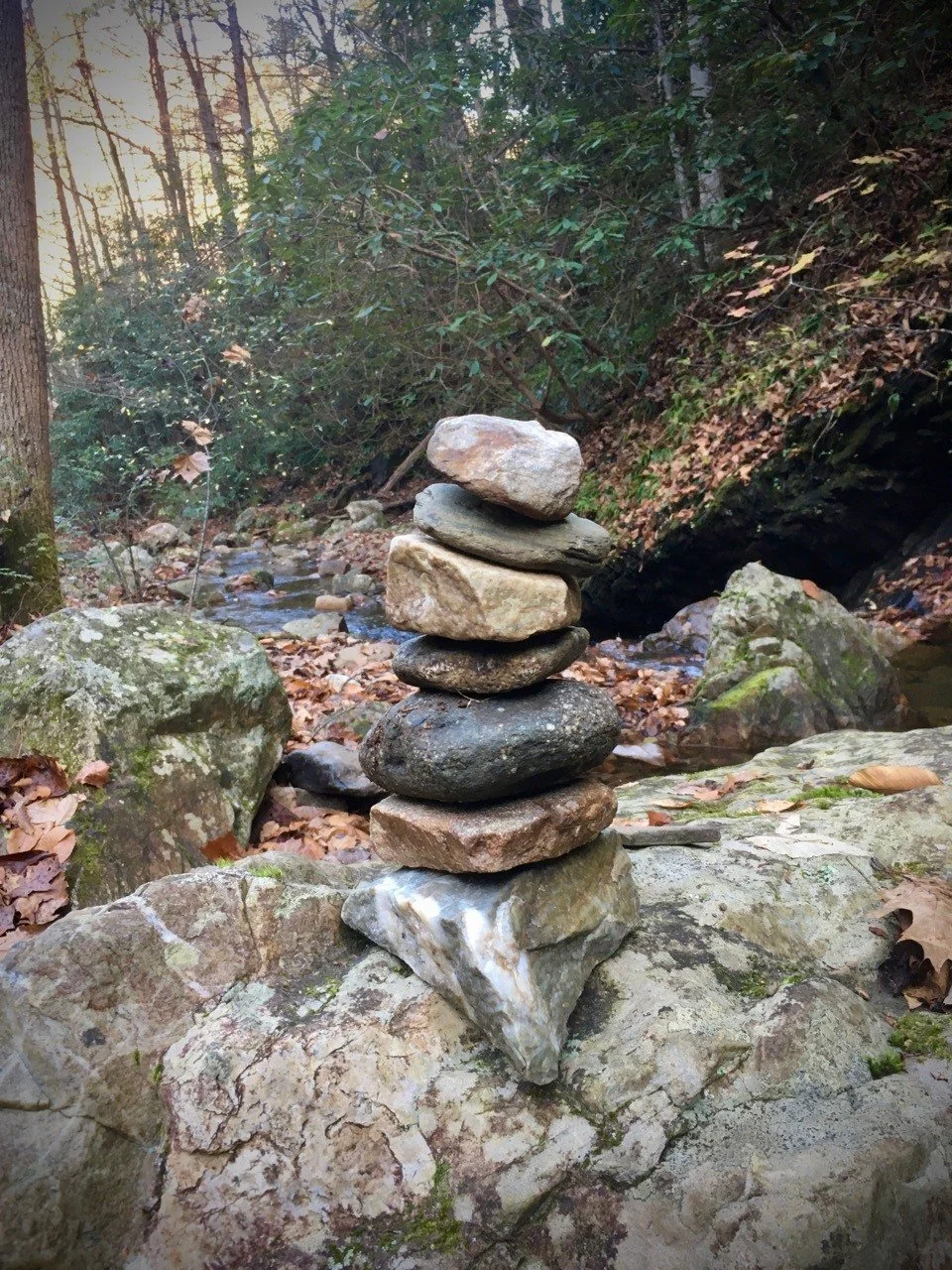
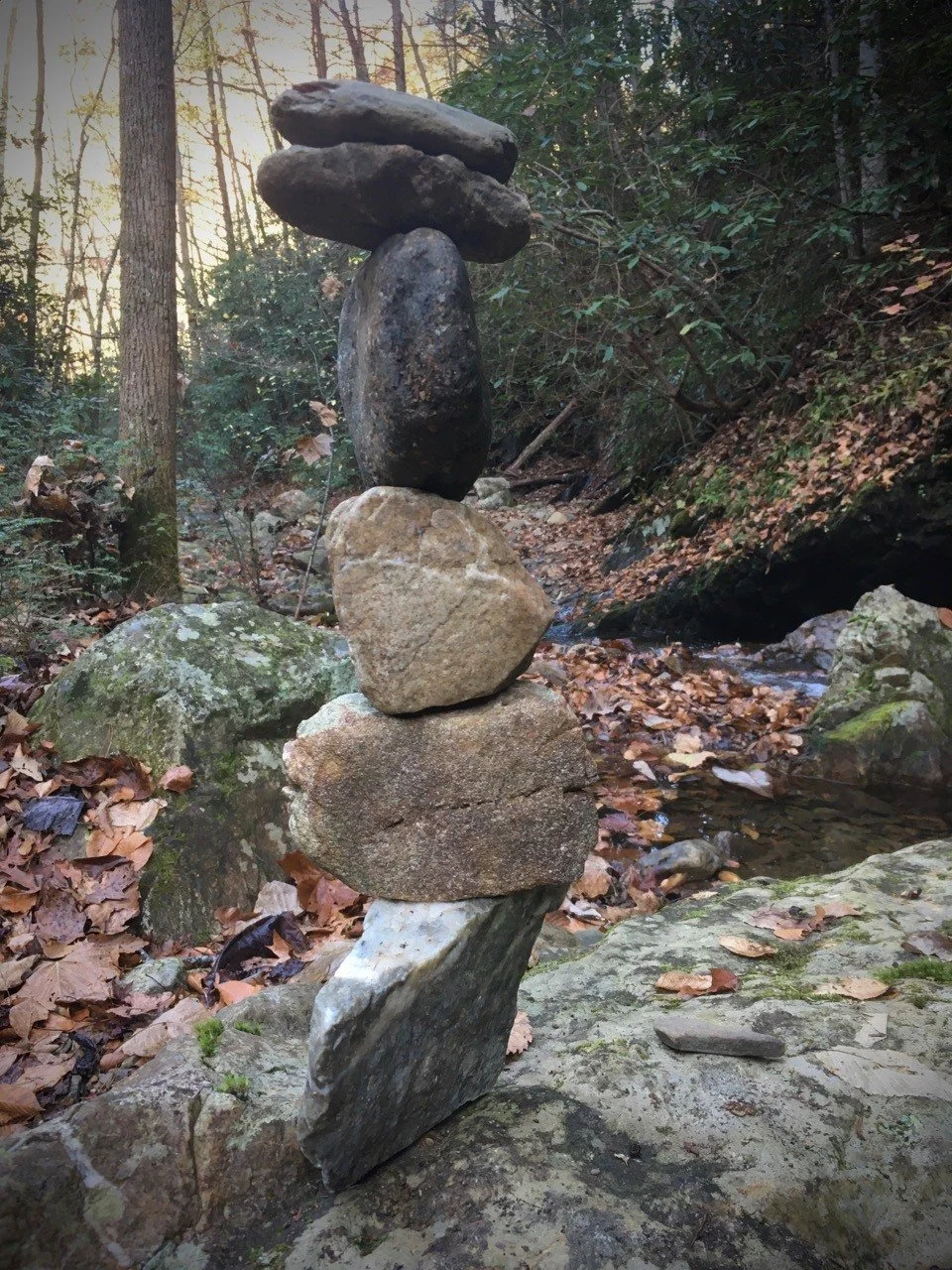
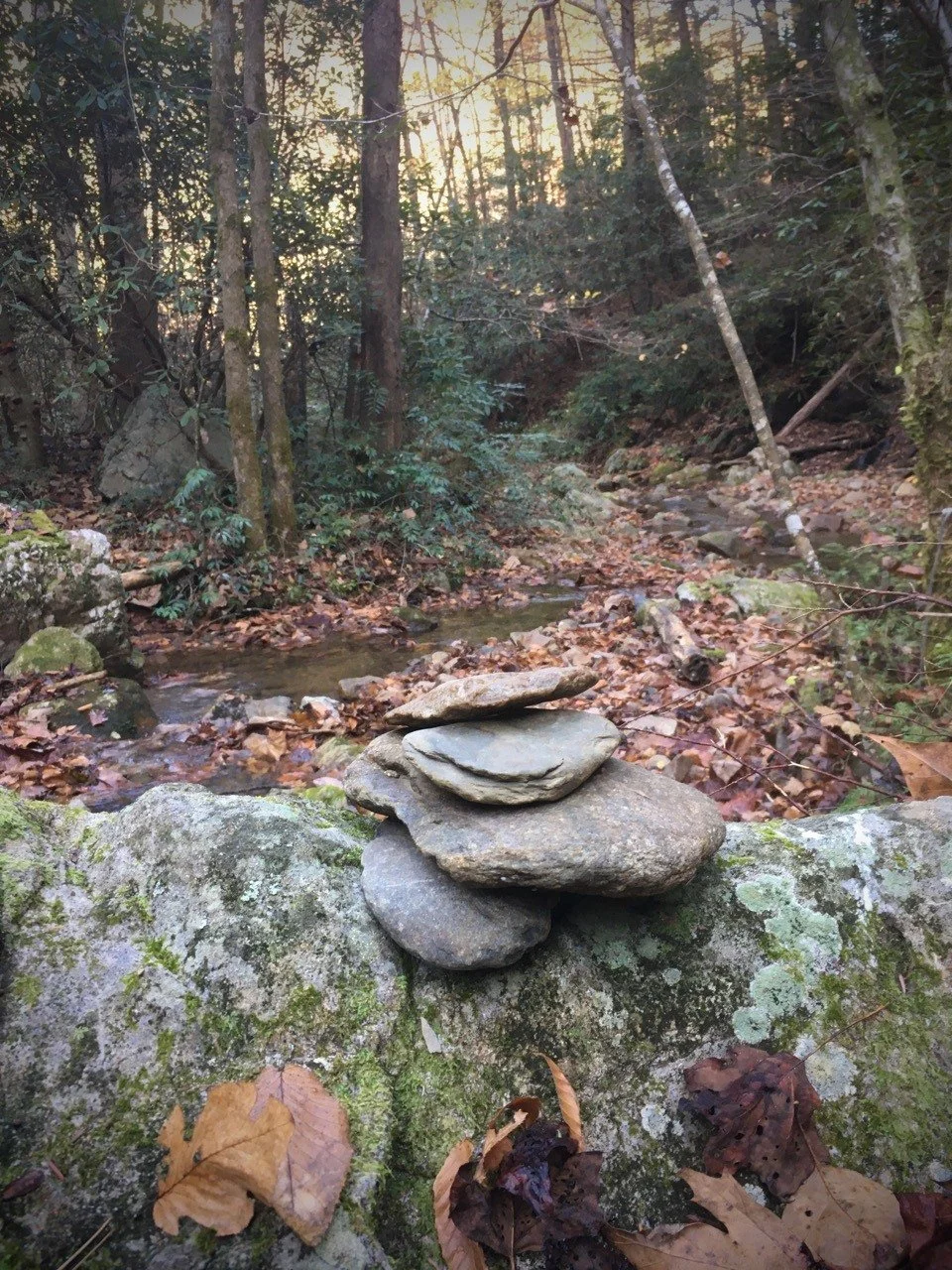

Same rocks, different configuration. (If you’re counting, one stack started with seven rocks and ended with six. I dropped one and it fell into a leaf pile and I didn’t try to find it.)
The process is as pleasing as finally getting everything to balance “right”.
It’s kind of like “what I do”
It occurred to me that the “assignment” of using given materials is like one way I collaborate with certain people: taking their “rocks” (text, images, etc) and using them to create something (a website) that is more dramatic, more pleasing, “more” than what they would have created on their own. Even without doing any editing a better presentation can be made, and the results can be both astonishing and satisfying. I enjoy the well-defined parameters and the creativity that can blossom within them. It especially feels good when I am able to make space for “rocks” that maybe are harder to work with — not as inherently pleasing, perhaps — and they become part of a larger assemblage that works.
Wanna try rock balancing?
Everything I know about doing this I learned from Peter Juhl’s short and insightful book Center of Gravity: A Guide to the Practice of Rock Balancing. One small section of the book clearly teaches the fundamentals and you may amaze yourself (and others!) with how quickly you start making noteworthy balances.
How I got started
When I lived in San Francisco (2000 – 2006) man-made rock formations appeared along the coast line, improbably balanced into columns. Years later I learned they were the work of (or inspired by) Bill Dan. At some point while walking through the Palace of Fine Arts I saw a Snapple bottle balanced on edge on a pillar base. If you click through to the Bill Dan entry in Wikipedia that I linked above you’ll see a can he balanced in just such a way. Did he balance the Snapple can I saw? I don’t know. But I was shocked, mystified, and intrigued by what I saw. It stayed with me.
Sometime in the 2010’s I started accumulating “board” games in which the goal is to stack various things. One of them (Rukshuk) even had fake rocks used to create simplified versions of real-world rock formations. Finally I realized I really wanted to stack real rocks which led me to the book I mentioned. (Kind of like how after years of hand-drumming I realized what I really wanted was to play a drum kit in a rock band, which is another story... and, hey, I guess "rock" is a thing for me, haha.)
Rock balancing is not exactly a compulsive hobby for me, but I greatly enjoy it when I do it. It is usually near running water, and the sounds combined with the focus create a meditative experience. It’s wonderful. Just writing this I find myself taking a slow deep breath and feeling more calm. If this is interesting to you, I suggest you try it yourself!
A note about destruction
Whether or not rock balances should be left standing is a sometimes passionately debated topic. Some say they are beautiful to come across unexpectedly. Some say they are unnatural and potentially dangerous. To be clear, this is NOT referring to wayfinding rock stacks/mounds used to mark trails. We are only talking about rock "art".
Often I take down my rock balances, especially if they are larger rocks. The last thing I want is some kid to find it and push on it — they always push on it — and have a big rock land on their foot or scrape their legs. Although, the more precarious balances don't last long on their own, anyway.
As for whether they should be taken down for their unnaturalness, I have issue with the premise. In terms of immersion in nature, a few rocks stacked up is less jarring to me than, say, signage about trail names and campsite locations. Furthermore, I am always on an unnatural human-made trail. The human fingerprint is with me throughout my walk whether I choose to focus on it or not.
If someone wants to knock down and strew a found rock balance I don't object to that. The structures are made to be ephemeral. I also don't object to the person who left it standing in the first place. Overall it just doesn't seem like a thing to get too worked up about either way. Live and let stack, live and let strew.
I will be a hummingbird
A hummingbird helps fight a raging fire, a drop of water at a time. Remembering the moral of this story inspired me. Here’s what I did.
Years ago my kids starting watching videos through the website The Kid Should See This (aka TKSST, highly recommended for everyone, not just kids).
Aside: I sometimes joke that the TKSST videos are educational-ish enough that you will feel okay-ish about your kids watching them all day. Seriously, though, there is a lot of interesting viewing there, curated and organized for your convenience.
One video that struck a chord with me was the animated fable I Will Be a Hummingbirdfrom "Dirt! The Movie". Check out the short video and story (also partially shown in still images and text on TKSST) by clicking on the link or watching the video below.
If you don’t want to watch the video I’ll give you the gist: a hummingbird helps to fight a raging fire, a drop of water at a time. Other animals label the hummingbird’s efforts as insignificant, but the hummingbird is insistent that it is helping in the way that it can.
Remembering the message of the story helped me finally decide to put a Black Lives Matter banner on my website and write about it here.
I know it’s a tiny gesture on an even tinier speck of the internet.
But you’re here with me now, so I’m talking to you. Not trying to convince you of anything. Just letting you know how I feel about it: black lives matter.
For some reason this message hit home most when I saw a take on the “All Lives Matter” response to “Black Lives Matter”. Basically, it was this:
Yes, all lives matter. But all lives can’t matter until black lives matter.
Equality, y’all.
I don’t want to pretend like racism doesn’t affect me.
Putting up a website banner is something I can do to show solidarity. Maybe it will be a stepping stone to other personal action.
Yes, it’s a drop of water on a raging fire, perhaps only significant to me but still significant in that it is something rather than nothing.
I didn’t want to live with nothing anymore.
Thank you for reading.
Moana, Lisa Simpson, and Me
A profound personal resource reinforced by animated badasses.
Here’s a tiny thing to try right now.
Take your name and insert it into this sentence: I am [your name].
Say it out loud (or just think it with clarity).
Straighten up and say or think it, with conviction. Deep breath. Again.
How does that feel?
Moana
I love the Disney movie Moana. In a climactic scene/song Moana connects with her inner power and belts out “I am MO-AH-NAAAAAA!” and sitting in the dark with my family I full-on bawled with a runny nose and everything. Even now just hearing any part of I am Moana (Song of the Ancestors) I tear up and break into a light sweat.
Yes, the visuals and the music and vocals have a big emotional effect but the idea of self-empowerment and determination is profound.
It’s even better when you add in the previous line from the song:
Come what may, I know the way
I am ______
Lisa Simpson
Many years ago I had a similar core memory experience watching The Simpsons. Young square peg Lisa Simpson idolizes a substitute teacher who believes in her and brings out her best. As he is leaving (on a train, for extra drama) he gives her a note that he says has everything she ever needs to know whenever she feels alone. The note reads, in its entirety: You are Lisa Simpson. Just typing that out right now I have an emotional reaction.
Everything you need to know.
Translation: the answers are within you.
Me
I think about this when I have questions in my life and I’m feeling indecisive or lost.
When I’m not sure what to do or how to act.
I know the way.
I am Kirk Roberts.
Sometimes it takes a while, sometimes it requires asking the right additional questions, but answers eventually emerge from within. Always.
You
Try it with your own name.
It will always be there when you need it.
Why everyone who takes appointments should have an online scheduler
Do you take appointments for your business? You need an online scheduler. Period. Here’s why.
The reasons can be summed up in two words: FRICTION and TIME.
Friction
Believe it or not, there are people who don’t want to have to call you, or email or text, either (whether they are introverts, just busy, or whatever). If those contact methods are their only options the friction between “no appointment” and “appointment” may go up to an intolerable level. As a business owner you should want to reduce that friction as much as possible.
Time
Time is money, certainly for you, and also likely for your clients. It takes time/money to go back and forth with texts, emails, or calls. And it’s a pain. As a business owner you should want to reduce pain as much as possible (even small amounts).
How it Works
I use an online scheduler and can’t imagine going back to the old way. It’s so simple: someone requests an appointment, I send them a link to the scheduler. Existing clients learn to use the scheduler. They see all the days and times that I’m available and they pick one that works for them. I get a message saying an appointment was booked. Done. We didn’t even have to talk, email, or text. Easy and fast.
Cool Details
Note: this is based on my online scheduler of choice (see below) but chances are that all the major players have similar features.
- You can require payment at the time of booking.
- You can set parameters and limits such as “only 12 hours in advance” or “only 3 hours of appointments on Wednesday”.
- You can have intake forms attached to the booking process for common questions.
- You can sync it to your digital calendar of choice.
- People can reschedule or cancel without consulting me (I like empowering my clients).
- If a person chooses a Zoom appointment my scheduler automatically includes a link to the meeting room in the email confirmation, email reminders, and optional "add to your calendar" event. (This required me performing a one-time task of setting up an integration between the scheduler and Zoom.)
True Story
I once booked a haircut with a barber because his online scheduler made it so easy, even though I was iffy about my previous experience with him. Talk about reducing friction! Got him an extra appointment.
Surprise!
I’ve had people ask for an appointment, so I send them the scheduler link. Then I get the notice that they scheduled the appointment and it’s two weeks from now! Glad that I didn’t take the time to send a message about what my availability is over the next few days.
Another Surprise!
It’s really awesome when I get a message out of the blue that someone booked an appointment without us needing to communicate otherwise AT ALL. This cannot be overstated.
Responses to common concerns
- You can set your availability schedule to whatever you want. This may or may not line up with your business hours, your choice.
- You can make it so people can’t book same day (I’m repeating this because it was a big deal for me).
- You can manually book appointments in or out of your “office hours” (people don’t HAVE to use the online scheduler, but it’s available to them if they do).
- The one I use costs about $16/month, way less than the time I would otherwise spend making appointments (and it’s a cool pro perk for clients to save time, too).
- To reiterate, using an online scheduler is not an "all or nothing" choice. It can complement your current ways of taking appointments. Just don't be surprised if many/most of your clients end up preferring to use it rather than "the old-fashioned way".
- Yes, it is rather critical that you yourself use a digital calendar such as Google Calendar or Apple Calendar. You have to be willing to manage appointments on a computer or device. While you could theoretically manage this entirely with your scheduling software of choice a huge benefit is in syncing with a digital calendar you already use. If you don't already do that it is possible to learn but a bigger leap to make.
Which One?
I use Acuity Scheduling (now also known as Squarespace Scheduling) and have clients who use it, too. Previously I used You Can Book Me, which is also good.
I have seen people use Square and it works well for me as a client, but I don’t know about the capabilities for the provider (you). Another one is Calendly, which I am iffy on having worked with it for clients. The sticking point for me as a website creator is that these services don't seem to embed very well so it is cleaner to link out to the hosted scheduler rather than include it within a client website.
Seriously
Are you in business? Do you take appointments? Get an online scheduler. Do it for your clients if not for yourself.
If you need help setting it up I know how to do that. You can use my online scheduler to set up a consultation :-)
Domain-based email for Gmail-addicts
Did you know that you can keep the Gmail interface AND manage your personal and business email in one window?
Shocking but true: there are business people who still use a free email address* for their business email.
*You know, @gmail.com, @outlook.com, @hotmail.com, etc.
Please, if that’s you, it’s time for an upgrade.
Go Pro
You could be projecting a MUCH more professional image using a domain-based email address (e.g. @your-company.com). And you’d also be promoting your company/website every time you send an email! All for a practically negligible subscription fee (or maybe even free through your website’s hosting).
And — this is point of this little essay — if you use Gmail, you can even continue to use the Gmail interface AND manage personal and business email in one window.
This may also be possible with other free online email accounts, I’ve just never had a reason to explore it.
How (sort of)
All you need is:
a Gmail account (of course)
a registered domain (e.g. yourcompany.com)
an email-hosting service*
some know-how about which buttons to push**
With the proper “wiring” in place your domain-based email goes to your email host and is forwarded to your Gmail account. From there you can reply and send it straight out of Gmail and it arrives to the recipient as if it came from your domain-based address. The secret is that Gmail routes your message through your email host’s server.
So you can access and send your domain-based email from the familiar (and powerful) Gmail interface, right along-side your non-company Gmail address.
*Which email-hosting service?
It may be that you already have email hosting through your webhost and can use that, such as Bluehost or GoDaddy. (I hope it isn't GoDaddy.)
Or maybe you use a hosted site-builder service that doesn’t provide email, such as Squarespace or Weebly.In the latter case check out Namecheap Private Email (less than $1/month) or G Suite ($5/month).
**I can set this up for you
It’s easy when you know how, but I appreciate that this stuff can be confusing.
If you want help, that’s part of what I do. Reach out, I’ll be there.
Please, the key thing is that you get help somewhere and stop using that @gmail.com address for your business.
You and your business are better than that.
Conspiracy Santa: the Anti-Grinch
Group gift-giving made way more fun, collaborative, on-target, and mindfully less voluminous. Perfect for teams or families, at holidays or anytime a group gift-exchange is in order.
I admit it: I am a Grinch.
Or rather, I *was* until the concept of Conspiracy Santa saved Christmas for me.
How Conspiracy Santa Works
get a group of people who will participate
establish the ground rules of what a gift can be (budget, theme, timing, whatever)
assign each person a giftee within the group, Secret Santa style
start an email thread for EACH person, CCing everyone in the group EXCEPT for the person whom the thread is about (e.g. a group with 8 people will have 8 separate email threads)
discuss on the threads what each giftee likes and dislikes, blue sky ideas, potential gifts, specific links, etc
close the discussion/voting and each person gets a gift for their giftee
eagerly anticipate when everyone will get their gift
We did this last year for the eight geographically-dispersed adults in my original family (including spouses) and it was so good we’re doing it again this year.
My Grinchiness: a Retrospective
I’ll tell you what I didn’t like about gift-giving before (that I admit are MY issues, not issues with gift-giving overall):
isolation and pressure: it felt like it was up to me to figure out what to get for each person
feeling cheap: I didn’t think I had enough money to work with, especially compared to others’ means (comparison is the thief of happiness)
feeling unsure: I dislike clutter and didn’t want to give clutter, could I really think of a good idea for everyone?
as a general rule, I hate gift cards (which could be another post in itself)
volume: does everybody really need a gift from everyone? Seeing so many presents felt depressing for the consumption of it all.
Previous to Conspiracy Santa, I just felt unhappy leading up to the “big day” and even unhappier on the day itself. Yep, total Grinch.
The Anti-Grinch Solution
Conspiracy Santa neatly solves all of those issues by creating contained “communities” in the email threads where we can discuss and get excited about ideas for each giftee. We use a soft budget that is much higher than I would have spent on any one person if gifting traditionally.
We are in cahoots! I can contribute thoughts about gifts for everyone but the pressure isn’t on me to be the one to decide, we all do that together. Ideas can build and evolve: “I never would have thought of THAT idea, but now that I hear it what about if we…” The spirit of collaboration is strong and I love it.
Each person gets one gift from the group (the gifts are to be marked as from Conspiracy Santa, and part of the fun is trying to keep the associations secret). Volume is reduced and quality is enhanced.
This new tradition has brought the season a lot of joy for me, where previously there was apprehension and crankiness. Grinch begone!
Origin & Tips
The Conspiracy Santa idea comes from this blog post: https://zapier.com/blog/conspiracy-santa/
The email thread starting service is unfortunately not working anymore, so this year I had someone else start my thread (I sent them the boilerplate email for forwarding) and started all the other threads myself.
Any group is going to need a prime mover who will kick things off and nurture any threads that may be languishing. It feels helpful to add ideas, no matter how off-the-wall, rather than just prompt people over and over. You know, light a candle rather than curse the darkness.
We are using https://www.drawnames.com/ for the name draw. Tip on that: set up exclusions so people don’t draw the people they are most familiar with (e.g. spouses). Learned from last year’s experience!
Love
Conspiracy Santa is so good. It makes my heart grow three sizes. I can’t recommend it highly enough.
A happy merry season to you and yours, whatever holidays you celebrate and however you gift (if at all)!
The Hourly Billing Renaissance
Maybe hourly billing isn’t the bugaboo I’ve been led to believe. In fact, maybe it’s EXACTLY what I need to have my dream professional life, and maybe it’s actually better for my clients, too.
Maybe hourly billing isn’t the bugaboo I’ve been led to believe.
In fact, maybe it’s EXACTLY what I need to have my dream professional life, and maybe it’s actually better for my clients, too.
In other words, perhaps ALL the work I do should use the Flexible Retainer model.
I’ve tried it a few times now, and am happy to report it has gone really well.
Projects get started faster. I still need to estimate, but the estimates are much more “ballpark” and presented in a range. Project agreements are simpler.
Projects tend to launch sooner. We focus on producing rapid improvements. I can switch roles fluidly as needed to help the project succeed. Flow is enhanced. It simply feels easier and more natural.
My clients trust me, and I work hard to earn that trust. The relationship feels even more like a collaborative partnership rather than vendor/buyer.
For years and years I was told (and believed) that fixed-fee was the best way to work.
Now I realize that hourly work may have much broader applications and benefits than previously thought.
The relationship between a website, an email address, and a domain
Because if you're going to buy and own a domain, website, and email you should know how they work on a high-level.
Say you enter a web address* into your browser or send an email. What happens next?
*a.k.a. a URL: Uniform Resource Locator
What is the domain?
A domain is something like yourwebsite.com
In https://www.yourwebsite.com/some-section/some-page the domain is still just yourwebsite.com
FYI — the .com part is known as a top-level domain (TLD). There are hundreds of TLDs available, such as .buzz and .clothing
FYI 2 — a subdomain is the part that comes before the domain, like in www.yourwebsite.com or news.yourwebsite.com the www and news parts are subdomains.
A domain is registered at a domain registrar.
Where does the domain point to?
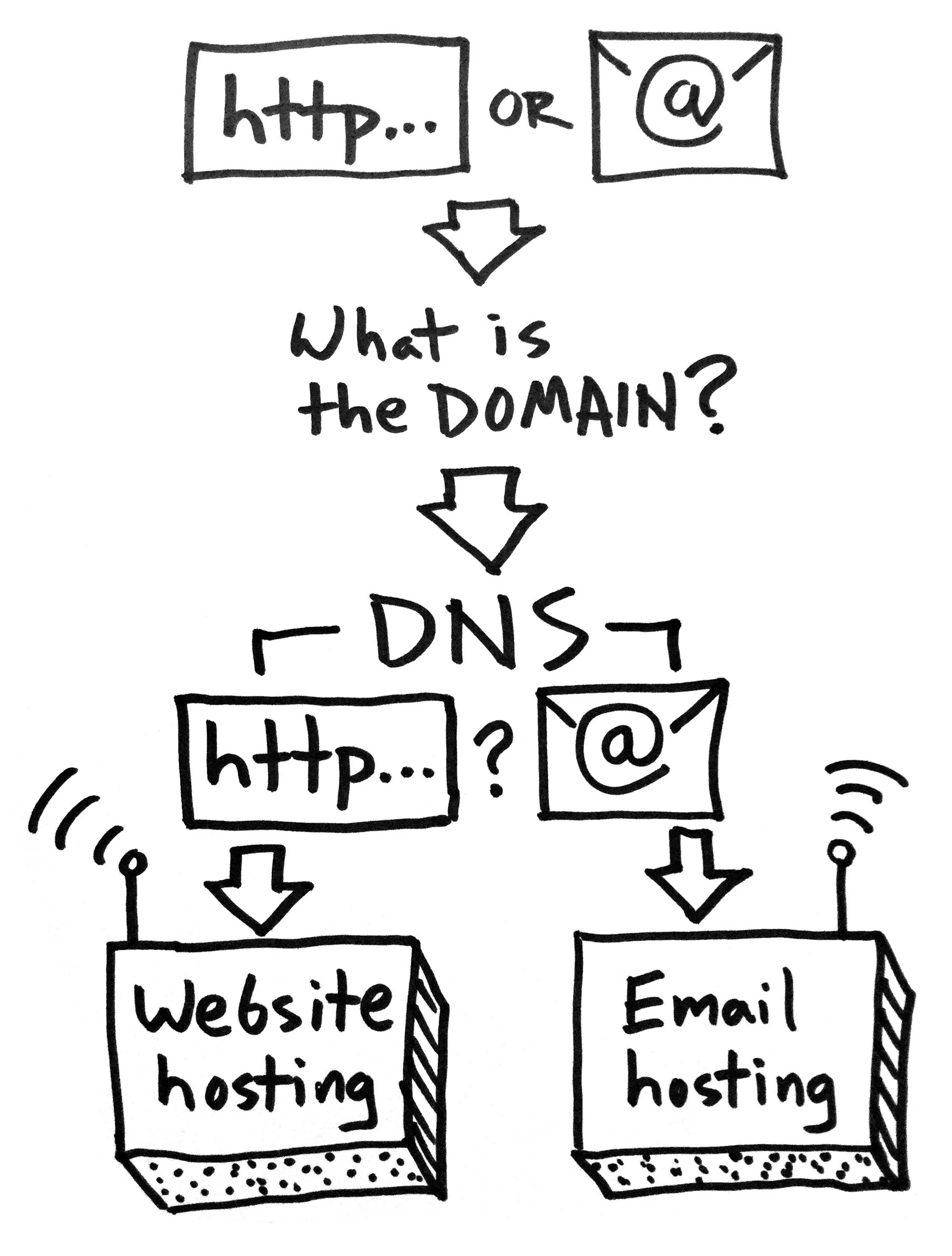
The internet looks at the Domain Name Servers (DNS) of the domain to see where to send the web address request or email. It’s possible to send a web address request to one place and email to another.
Webserver / Webhosting
This is where the files that make up the web page live (which may in turn point to other webservers for more resources like images, videos, etcetera).
Email Hosting
This is where email lives and gets routed through. It’s essentially just a webserver that can handle email.
So the process looks kind of like this:

The Confusing Part
Lots of companies will handle all of this for you so people often think they are all one thing that can’t be separated. In fact your domain, website hosting, and email hosting can, and arguably should, be separated. The reasons why or why not to separate them are a whole other topic!
How I (Generally) Recommend Doing It for Your Own Website
Domain: domains are essentially a commodity, so you might as well buy them cheaply (.com domains should be about $11/year). I swear by Namecheap, which offers free email forwarding as a perk.
DNS: keep your DNS “nameservers” at your domain registrar, for flexibility’s sake.
Website hosting: many websites will be fine on “shared” webhosting, but it’s usually worthwhile to pay up for the premium shared hosting (sometimes labeled as “pro”, “turbo”, or the like). If you use a hosted site builder like Squarespace or Weebly, the hosting is part of your subscription.
Email hosting: if you can, host your email with a dedicated provider such as Google’s G Suite. This seems to avoid some of the issues that can come from using the “free” email included with your webhosting package.
I run into questions about this stuff a lot, so I hope this helps clear things up!
Flashback: Evergreen Advice from CFC 2013
For my own reference and yours, here are my notes from the short talk I gave on the “How to Grow Your Business (With or Without Employees)” panel at the Creative Freelancer Conference at Moscone West in San Francisco held June 22-23, 2013.
For my own reference and yours, here are my notes from the short talk I gave on the “How to Grow Your Business (With or Without Employees)” panel at the Creative Freelancer Conference at Moscone West in San Francisco held June 22-23, 2013.
I deviated and ad-libbed, but this will give you the general idea of the content.
Answers
Before you look for answers, make sure you’re asking the right questions. There are lots of answers out there, but most of them have nothing to do with you.
Authorship
You are the designer of your own life. It is the biggest and most important project you’ll ever have. You are living a personal Choose Your Own Adventure book every day. You are the director and star of a real-time movie that is unfolding as we speak. Your life is a creative work of art. You may have sources, but you are the only author. Create your masterpiece.
Criticism
Criticism reveals more about the critic than the object being critiqued. This is also true of self-criticism.
Bravery & Fear
Bravery cannot exist unless there is also fear. It is normal to feel fear. Fear is an opportunity to be brave. The reward of bravery is freedom. Know the difference between good fear and bad fear. The difference is in the level of excitement you feel with the fear.
Self-Confidence
The most important quality in your life toolkit is self-confidence. Everything else is details. EVERYTHING. If you don’t have self-confidence, fake it ’til you make it. If not you, who? If not now, when?
Time
Every person on the planet — young, old, rich, poor, healthy, sick — has the exact same amount of time in the day. No more, no less. What are you giving your time to? What is not getting your time but should be?
Growth
Does growth have to mean more? Can it mean better? Can it mean less? Can it mean lateral movement?
You decide for yourself. And feel free to change your answer whenever you feel like it.
Thank you for listening.
Making New Year Resolutions Stick
I love the new year. It’s a great time to take stock of what’s important and set intentions. Here are some ideas I keep in mind to help craft my resolutions (or goals, or intentions, or tasks, or whatever) so they are meaningful and can make it out of January.
I love the new year. It’s a great time to take stock of what’s important and set intentions. There’s nothing like the symbolism of the annual calendar flip to jumpstart the process.
But… change is hard and new (good) habits often don’t form easily. Here are some ideas I keep in mind to help craft my resolutions (or goals, or intentions, or tasks, or whatever) so they are meaningful and can make it out of January.
- Think small. It’s easy to overwhelm yourself, so set an attainable goal then after you hit it you can make a new bigger one.
- Think evolution. Rather than revolution. Look for opportunities to build on something and expand it.
- Quantify goals. Nebulous goals are easily cast aside. Be hyper-specific about what you’re going to achieve.
- Think in categories. This can supply the “why” to help bolster the effort. For example: family, fitness, work, community, and personal.
- Go for higher frequencies, lower volume. It’s mentally easier to do something every day, and often more effective. For example: 10 minutes of yoga every day rather than 70 minutes once a week.
- Focus selectively. Pick out only a few items to address. Trying to change lots of things at once can cause everything to fail.
- Be accountable. Tell someone (or lots of people) you trust what your intentions are. Check in periodically with updates.
- Think long-term. Make a life change you think you could do forever, because it’s the right thing to do, for you. For example: rather than go on a diet, change your diet for good.
- Pay attention to language. Words have power; watch your self-talk. For example: it’s more powerful to say “I don’t eat sweets” than “I’m trying not to eat sweets.”
- Get back on the horse. Just because you flub up doesn’t mean you have to beat yourself up. Ask why it happened, make a change, and simply start again with a new resolve.
- Be real. Ask yourself: “Do I really want this? Why? How does this fit into my life? Is this the right time?”
- Remember this (via the Daily Calm): “Don’t give up what you want most for what you want now.”
Raise a glass of cheer to an evolutionary new year!